
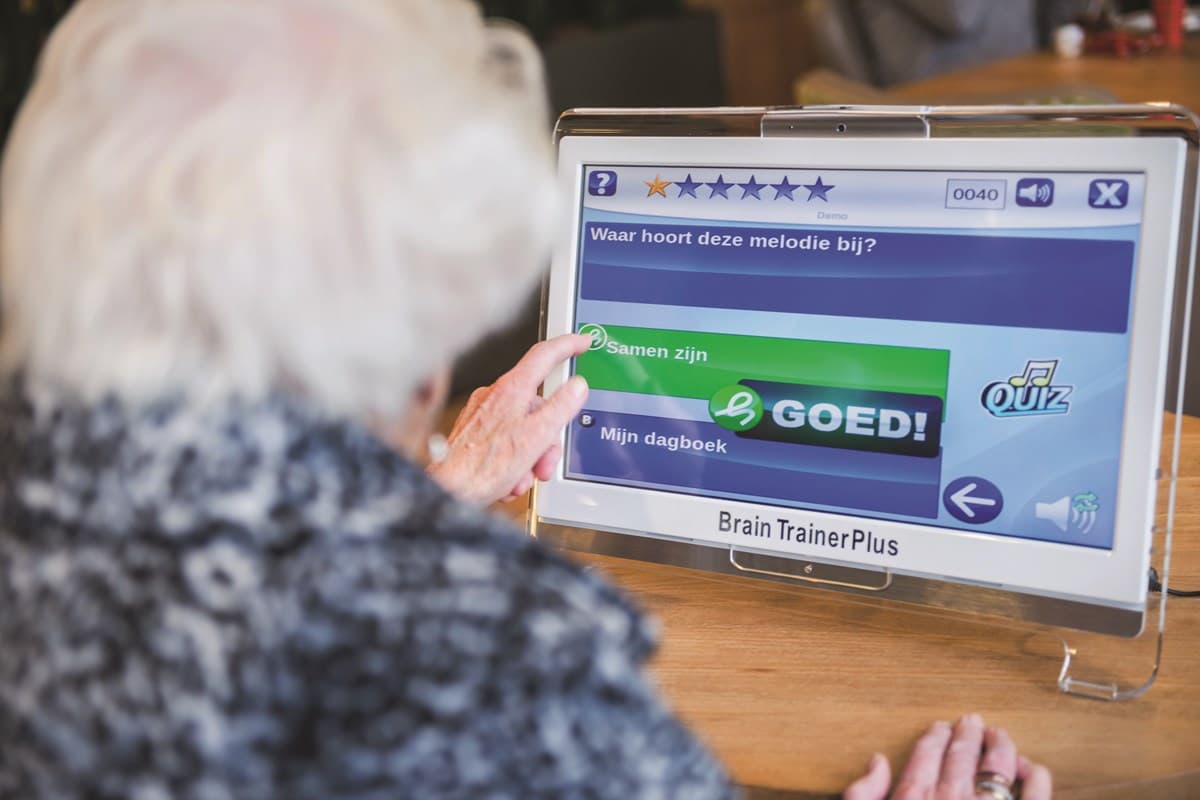
Effects of the BrainTrainerPlus™ on memory self-efficacy in the elderly
Beliefs about one's capacity to use memory effectively — Memory Self-Efficacy, or MSE — have an important role in research on cognitive ageing, because there is a correlation between age and MSE (Welch & West, 1995). There are multiple reasons why older people have a lower MSE than younger people (Hertzog, Hultsch & Dixon, 1989). Nevertheless, it is possible to increase MSE (McDougall, 2001). Sources that can raise MSE include positive feedback and mastery experiences. This study investigates the effects of the BrainTrainerPlus™ as an intervention for MSE in the elderly. The BrainTrainerPlus™ provides positive feedback and adjusts the level to every individual user, so there is a high probability of mastery experiences.
Participants were recruited in nursing homes and day-care centres in Deventer and Apeldoorn. 53 participants took part; they were divided into an experimental group (N = 30) and a control group (N = 23). Both groups had a five-week training period in which they performed the 'Daily Training' on the BrainTrainerPlus™ fifteen times. The experimental group received positive feedback on their answers; the control group did not.
MSE was measured with the Metamemory in Adulthood Questionnaire (MIA). The Geriatric Depression Scale (GDS) was used to measure mood. Quality of life was measured with the MOS Short-Form Health Status Survey (SF-36), and cognitive functioning with the Cambridge Cognitive Examination (CAMCOG). These tests were administered at three moments: a pre-test, a test directly after the training period, and a post-test three weeks after the training finished.
In the experimental group, MSE improved significantly directly after the training period. There was also a decrease in depressive symptoms and an improvement in cognitive functioning. In the control group there was no increase in MSE, but cognitive functioning did improve. Across the entire research population there were significant improvements in MSE, mood and cognitive functioning directly after the training period. In the follow-up period, memory functioning improved further compared with the test taken directly after training, while the general health evaluation decreased over the same period.
The BrainTrainerPlus™ appears to have positive effects on memory self-efficacy, mood and cognitive functioning. This provides evidence for the presumed sensitivity to positive feedback in this target group, and indirect evidence for the effectiveness of the BrainTrainerPlus™. In doing so, the BrainTrainerPlus™ proved its usefulness in the care of the elderly.
Graduation paper, Applied Psychology — Saxion University of Applied Sciences, Deventer, Netherlands. Academic year 2013/2014.