
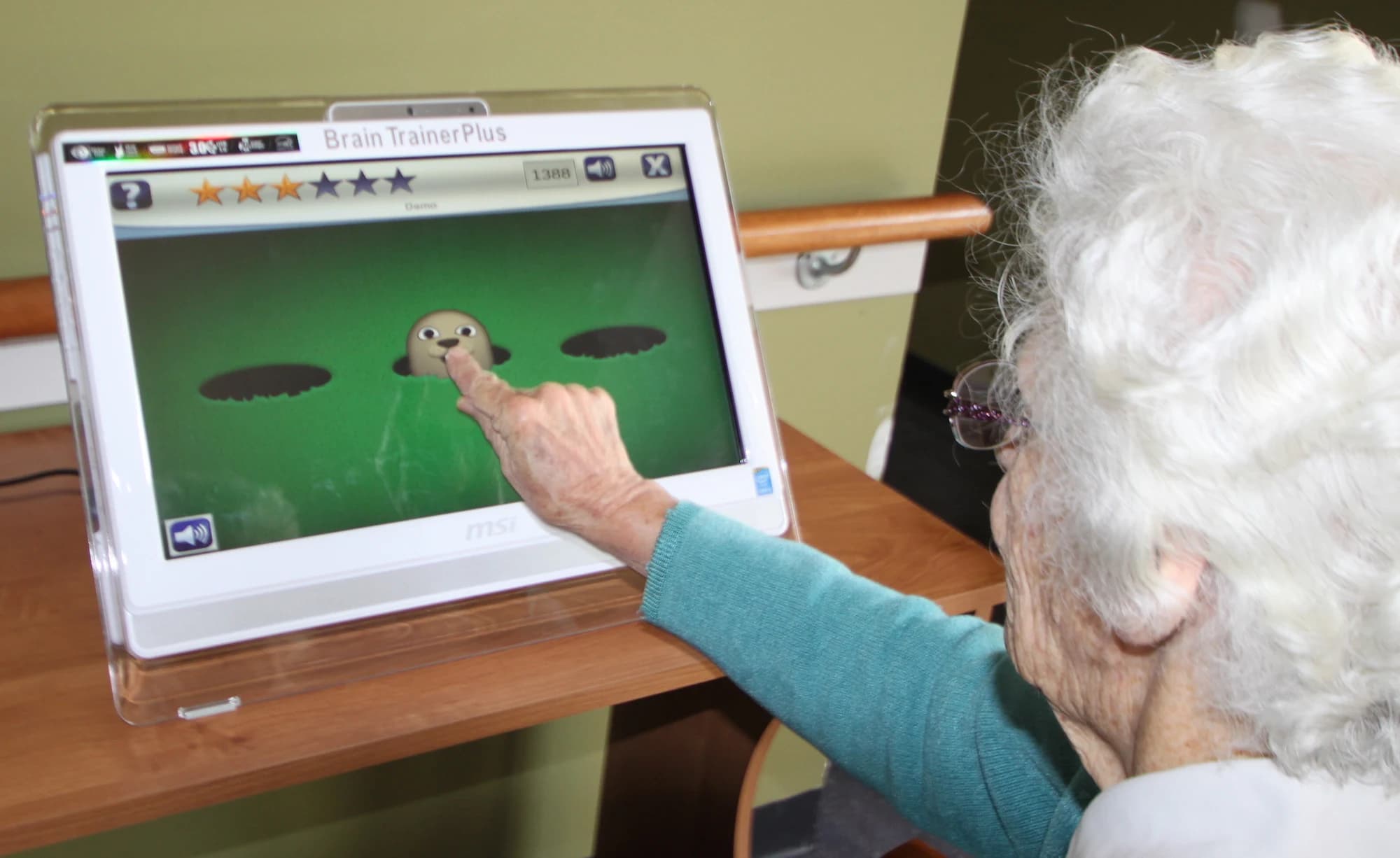
Crosswords on the table, Sudoku in the newspaper, a tablet loaded with brain-training apps, a chess board in the corner of the lounge. Mentally stimulating activity is everywhere in aged care — and families ask about it constantly. But does any of it actually protect the brain, or just pass the time?
It's a fair question, and the honest answer is more interesting than the marketing. We read three of the studies that sit behind the headlines — the same ones cited by UNSW clinical neuropsychologist Dr Nicole Kochan — to separate what the evidence shows from what it doesn't.
1. Learning something genuinely new (tablets)
In a study published in The Gerontologist (Chan, Haber, Drew & Park, 2016), 54 adults aged 60–90 spent three months learning a demanding new skill: how to use an iPad. Those who took on that challenge showed greater improvements in memory and processing speed than peers who spent the same time on socially pleasant but mentally undemanding activities. The lesson isn't "tablets are magic" — it's that novelty and genuine challenge seem to matter more than simply staying busy.
2. Playing board games (over 20 years)
A French population study published in BMJ Open (Dartigues et al., 2013) followed 3,675 older adults for two decades. Regular board-game players were about 15% less likely to develop dementia, and showed less cognitive decline and lower rates of depression, than non-players. It's observational — so it can't prove the games caused the benefit — but the link held up over an unusually long follow-up, and the social, face-to-face nature of board games may be part of the story.
3. Commercial brain-training games (16 trials pooled)
The most cautious of the three. A 2020 meta-analysis in Scientific Reports (Bonnechère, Langley & Sahakian) pooled 16 randomised controlled trials — 1,543 healthy adults over 60 — testing commercial games like Lumosity and Nintendo Brain Age. The result: modest but real improvements, largest for processing speed (the ability that declines most readily with age), with smaller gains in working memory, executive function and verbal memory.
How much do brain-training games help?
Average effect size (standardised mean difference) across 16 trials — Bonnechère et al., 2020.
No significant effect was found for attention or visuospatial ability. Higher = larger improvement.
The honest caveats
It would be easy to stop at "the research says brain games work" — but the evidence asks for more care than that.
What the evidence does not say
- The gains are modest, and most trials were in healthy older adults — not people already living with dementia.
- There is minimal evidence that commercial games change everyday function or the course of established dementia.
- No single activity is reliably better than another. There is no magic app.
So what actually matters?
Read across all three studies and a consistent picture emerges. The benefit isn't locked inside any particular product — it comes from how the activity is done. The research, and the neuropsychologists who interpret it, keep pointing to the same ingredients:
- Novelty — learning something genuinely new, not just repeating what you're already good at.
- Challenge — it should stretch you a little.
- Variety — engaging memory, attention, reasoning, language and processing speed, not one narrow skill.
- Enjoyment — if it isn't fun, people stop. Adherence is everything.
- Social connection — doing it with others adds a protective effect of its own.
This is the idea of cognitive reserve: a lifetime of varied, stimulating, social activity helps the brain stay resilient and buffer against age-related change. It's also why "do what you enjoy, and keep trying new things" is better advice than "buy this one app."
What this means for your service
- Offer variety — rotate activities that work different cognitive skills, not the same worksheet every day.
- Build in social, group play — the connection matters as much as the content.
- Prioritise enjoyment and choice so residents actually keep going.
- Pitch the challenge right — stretching, achievable, and adjustable per person.
Where technology fits
None of this is an argument for or against screens. A touchscreen isn't better than a crossword because it's digital — it earns its place when it makes the right ingredients easier to deliver. A well-designed platform can put varied, multi-skill activities in one place, support group and one-to-one play, adjust the challenge to each person, and keep things fresh so engagement doesn't go stale — all without a pile of preparation for already-stretched staff. Used that way, it's a tool for delivering good practice consistently, not a shortcut around it.
The bottom line
Do brain games work? The most accurate answer is: mentally stimulating, varied, enjoyable and social activity is good for ageing brains — and the specific format matters far less than the ingredients. For aged-care teams, that's genuinely freeing. You don't need a miracle product. You need to make engagement varied, social, enjoyable and consistent — every day.
Sources: Chan MY, Haber S, Drew LM, Park DC. Training Older Adults to Use Tablet Computers: Does It Enhance Cognitive Function? The Gerontologist, 2016. · Dartigues JF et al. Playing board games, cognitive decline and dementia: a French population-based cohort study. BMJ Open, 2013. · Bonnechère B, Langley C, Sahakian BJ. The use of commercial computerised cognitive games in older adults: a meta-analysis. Scientific Reports, 2020. Context: UNSW Newsroom.
Talk to us
Want to see how BrainTrainerPlus supports varied, social, group and one-to-one engagement in your service? Send us a message and we'll be in touch.